‘Inclusion’ Marks the First Graduating Class of the Comprehensive Security Cooperation Course
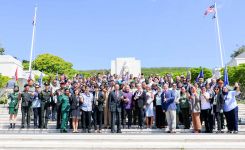
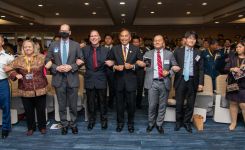
On March 30, seventy Fellows representing 30 different nations graduated from the first Comprehensive Security Cooperation Course 22-1 held at the Daniel K. Inouye Asia Pacific Center for Security Studies (DKI APCSS) in Honolulu, Hawaii, from February 24- March 30.
The Fellows ranged from high-ranking military officers, directors of government agencies, law enforcement, and leaders of nonprofit organizations. Fifty-seven of the Fellows traveled internationally from their home countries to attend the course. Five Fellows represented non-governmental organizations that included the Association of Southeast Asian Nations (ASEAN) and the International Committee of the Red Cross (ICRC).
During the 5-week program, the Fellows not only received executive legal education, but also gained insight into how other security practitioners engage in the Indo-Pacific region’s most pressing security issues. The Fellows received over 30 plenary lectures covering a broad scope of topics that included climate change, counter-terrorism, maritime security, gendered security, economics, crisis response, and disinformation. The unanticipated war in Ukraine warranted a change in curriculum and a plenary lecture on “Ukraine and the Indo-Pacific” was added to the curriculum.
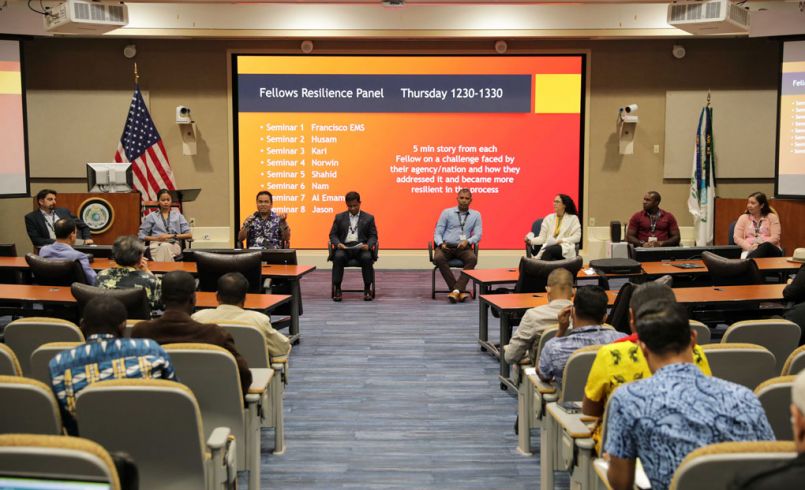
Throughout the course, the Fellows participated in eight separate, small-group seminars. In discussions and exercises led by DKI APCSS Professors, Fellows shared cross-culturally their ideas and best practices, brainstorming solutions through their collective knowledge from various security sector disciplines.
For Navy Lt. Cmdr. Mabnefo Ofodile, the Center’s value for inclusion was his biggest takeaway from the course.
“[Inclusion] was probably one of the biggest things we got here,” said Ofodile. “To be able to include everybody and hear everybody’s opinion. Sometimes with the people you work with sometimes you don’t value other people’s opinion. Being able to listen to everybody here. Everybody came from different lifestyles and different countries.”
Irene Kuntjoro, Senior Officer, Security Cooperation Division, ASEAN Secretariat, Jakarta, Indonesia, commented that her experience in CSC gave her renewed confidence in ASEAN and its role in the region as a center for cooperation between nations.
“Academics and op-eds always criticize the way ASEAN moves slowly,” said Kuntjoro. “But being here has given me a new perspective that, in a way, ASEAN is a solution to reduce the tensions in the region.”
For Erich Meir Jr. the practice of dialoguing between Fellows will be a skill he plans to use immediately. His organization, ICRC, uses humanitarian diplomacy to collaborate with the military, ministers of foreign affairs, and ministers of defense.
“The biggest takeaway is being open to cooperation and open to more relationships between countries. Meeting people and making friends will speed up all our interactions in the future.” said Meier.
The new CSC course aimed to approach learning from a holistic perspective with the goal of engendering the Fellows towards critical thinking, challenging assumptions, and recognizing connections between ideas, people and different agencies and fields.
“The best thing is that DKI APCSS teaches its participants and Fellows on how to think,” said Norwin Mohamad Nor, Principal Assistant Director, Ministry of Science, Technology and Innovation, Malaysia. “How to think strategically, how to think tactically. I believe that is the most important thing apart from building connections and camaraderie amongst Fellows.”
CSC 22-1 represented the Center’s first long course (5 weeks) since the start of the pandemic. To timely attend the course without being subject to a state-required quarantine, all Fellows were fully vaccinated. As the course progressed and local COVID-19 infection rates decreased, the Department of Defense lifted its mask-wearing requirement. In addition, the Mayor of the City and County of Honolulu relaxed COVID-19 related restrictions for social gatherings and required proof of vaccination to enter certain establishments.
Professor Deon Canyon led the CSC 22-1 Course Management Team that included Lt. Col. Michael Bucher(USAF), Dr. Sam Mullins, Dr. Ethan Allen, and Professor Mike Burgoyne.
The CSC course runs three times each year and enables mid-career and senior security practitioners to comprehend the Indo-Pacific region’s most compelling security problems. The course enhances the capacity of regional allies, partners and others to comprehend and cooperatively address complex security challenges in the Indo-Pacific region by advancing freedom, openness, prosperity, good governance, rules-based order, and a free and open Indo-Pacific. Fellows are empowered to make cooperative attempts to address these issues. The next iteration, CSC 22-2, is scheduled to take place in May of this year.