A New Workshop Aims to Modernize the Indo-Pacific’s Security Architecture

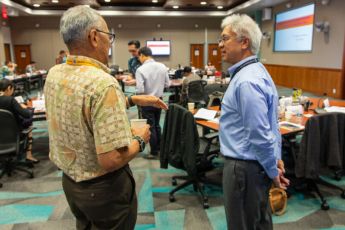
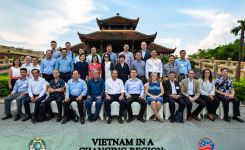
A new workshop, “Adapting Alliances, Partnerships, and Regional Security Architecture,” hosted by the Daniel K. Inouye Asia-Pacific Center for Security Studies (DKI APCSS), aims to modernize the security architecture in the Indo-Pacific. From February 6-10, 24 mid-level officials from 13 nations and three regional organizations participated in the workshop.
The participants included the United States, Australia, Japan, the Philippines, the Republic of Korea, Fiji, India, Indonesia, Palau, Papua New Guinea, Thailand, and Vietnam. The participants represented a demographic of mid-level officials whose responsibilities included alliance management, regional affairs, defense policy and plans, and foreign affairs.
At the program’s start, a survey revealed that almost two-thirds of the participants believed that the Indo-Pacific security environment was worsening. The participants attributed the declining security environment to climate change, new technologies, rising regional tensions, and increased economic competition. Throughout the week, the participants identified various security threats in the region and assessed their collective ability to coordinate a response during a crisis.
The workshop’s key insight was summarized in an aide memoire drafted by DKI APCSS professors. The participants agreed that a shared vision of the future and respect for the sovereignty of all nations is the most important principle for building the region’s security architecture. They also determined that pursuing the rules-based international order should be based on values over national or regional interests. Additionally, the participants emphasized the need to create more ad hoc caucuses of like-minded countries or “mini-laterals.” In addressing this need, the participants formed a mini-lateral group comprised of Vietnam, Indonesia, and Palau. This group will aim to establish an agreement on maritime awareness focusing on illegal, unreported, and unregulated fishing
The participants proposed the concept of “collective resilience” as a means to respond to new challenges and threats. According to Professor Victor Cha of Georgetown University, collective resilience is a multilateral approach to increase like-minded countries’ economic and political resilience against Chinese economic coercion. In following the concept of collective resilience, like-minded countries build a coalition, develop a shared response, and strengthen resilience.
The event aligned with the U.S. Indo-Pacific Strategy priority to “modernize our long-standing alliances, strengthen emerging partnerships, and invest in regional organizations.” It also supported the U.S. Indo-Pacific Command’s priority to increase mini and multilateral events with allies and partners. The program included an address from Jed Royal, Principal Deputy Assistance Secretary of Defense for Indo-Pacific Affairs.
According to Dr. Ginnie Watson, the workshop lead, the event has been two years in the making. In 2021, the Center’s College of Security Studies saw a need to modernize a regional security architecture constructed after World War II. According to Watson, the Indo-Pacific’s security architecture must modernize to reflect new realities and the legitimate shared interests of partners and allies to deter conflict. Watson hopes that the workshop will become an annual event with future workshops taking place in the region.