Maintaining society’s resiliency in the face of asymmetric warfare

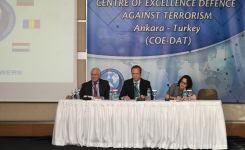
VIENNA, Austria (Apr. 22, 2016) – The Diplomatic Academy of Vienna held its 12th Annual Student Conference on 22 April, with the theme “Hackers, Contractors and Drones: Warfare in the 21st Century.” Dr Raphael Perl, Executive Director of thePartnership for Peace Consortium (PfPC), participating in the conference as an opening speaker and panel moderator, examined asymmetric warfare in the broader context of hybrid warfare, offering policy recommendations to help nations address threats posed by asymmetric warfare.
Addressing conference participants, Dr Perl recognized the important role that the Diplomatic Academy of Vienna plays in preparing future leaders to help resolve international conflicts, with graduates from the academy expected to provide the necessary thought leadership to address asymmetric warfare and related threats to international stability.
Dr Perl, defining asymmetric warfare as “that aspect of hybrid warfare in which individuals or small groups leverage weaponry or technology to inflict damage far out of proportion to what would have been possible for the same actors in a conventional war,” offered policy recommendations centered on Intelligence and Action.
Regarding Intelligence, Perl emphasized the need to leverage cutting-edge methods of social media network analysis and data correlation as a means to detect possible asymmetric attack planning, and for results of such analyses to be shared among international law enforcement and border control agencies.
Perl’s recommendations concerning Action focused on the need to disrupt the logistical capabilities of actors carrying out asymmetric attacks, while also suggesting that society must be continually prepared for the aftermath of asymmetric attacks through contingency planning.
In his concluding remarks, Dr Perl stated that an important societal goal in contending with asymmetric warfare should be to ensure that nations do not descend down the path of a police state, with the loss of freedom that such a path would entail. According to Perl, “In dealing with asymmetric warfare, we must be prepared to acknowledge and accept the inevitability of asymmetric attacks and losses, while maintaining the resiliency of our society to function in their aftermath.”