CSC 23-3: Fellows Navigate Uncertainty with Courage

In a world marked by evolving geopolitical security challenges, the Daniel K. Inouye Asia-Pacific Center for Security Studies (DKI APCSS) hosted the Comprehensive Security Cooperation (CSC) course 23-3 in Honolulu, bringing together 108 Fellows from over 30 countries in the Indo-Pacific region and beyond.
According to course manager Dr. Sungmin Cho, the course was not just a platform for academic learning but a testament to the courage of its participants, who braved uncertainty with the looming threat of a possible government shutdown.
The course was held from September 2 to October 25, with a possible government shutdown* taking place on October 1, just one-and-a-half weeks into the program. For weeks before the course, Cho and the Center staff developed multiple plans to navigate a government shutdown, ranging from drastically restructuring the schedule to canceling the entire course altogether. Ultimately, the Center leadership chose to continue with the class and restructure the program so that the Fellows could receive essential instruction before October 1
Said Cho, “Some suggested that we should cancel the course or end in eight days to remove any uncertainty, but we planned for success, not for failure.”
On the evening of September 30, the U.S. government announced a continuing resolution. The following morning, instead of boarding planes to their home countries, the Fellows boarded a bus for a team-building excursion around the island.
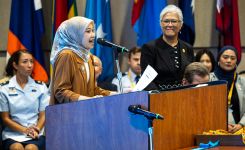
Rowena Tatad, a Fellow from the Philippines, was selected by her peers to deliver a commencement speech on the Fellow’s behalf. In her remarks, Tatad reflected on two pivotal moments that defined the uniqueness of this course. She acknowledged that the threat of a U.S. government shutdown and the unfortunate occurrences of the Israel-Palestine conflict and the Afghanistan earthquake were incidents that set this course apart from its predecessors.
Tatad emphasized the bond that developed among the participants due to the shared trauma of a potential government shutdown. She referred to this phenomenon as “trauma bonding,” which often leads to strong emotional connections among individuals facing high uncertainty and distress. However, she chose to reframe this experience as a testament to genuine peer support that accelerated social connections and a sense of belonging among participants from diverse backgrounds, cultures, and aspirations.
According to Tatad, it was this authentic peer support that fostered deliberate interactions, encouraged sincere efforts to engage with fellow participants, and, most importantly, created a platform for open and meaningful conversations—the uncertain times transformed into an opportunity for deeper insights and broader perspectives on various issues.
She also noted how current events like the Israel-Palestine conflict and the Afghanistan earthquake created opportunities for deliberate discussions. During the course, Fellows from the regions retold firsthand accounts, fostering in-depth discussions and insights into these global issues.
Throughout the course, events like “The Great Game” and “The Great Debate” provided effective platforms for simulating interactions between leaders, individuals, and governments with diverse interests and motivations. Additionally, the Fellows Projects encouraged participants to develop and initiate long-term projects that will improve the security environment in their home countries.
In her speech to her cohort, Tatad reflected on the transformation they underwent as a class. “We came here to DKI APCSS as strangers,” said Tatad. “But because of the shared understanding built over time about the interconnectedness and the shared and the transboundary nature of different issues, I believe that we acquire that sense that we now have this network of people and professionals whom we can work with. We have just acquired more opportunity and motivation to collaborate and cooperate on issues that matter, especially when they matter.”
Visit the CSC website for further details. The next Comprehensive Security Cooperation course is tentatively set to begin on February 14, 2024.
* A government shutdown occurs when the U.S. federal government’s funding expires, and Congress and the President cannot agree on a new budget or a continuing resolution to fund government operations. During a government shutdown, federal agencies and departments are forced to furlough non-essential employees and cease non-essential services, which would have included the course.
VIEW MORE PHOTOS ON OUR FACEBOOK PAGE