Workshop enables DKI APCSS, ASEAN nations to build education cooperation
CSC14Jan16-2.jpg
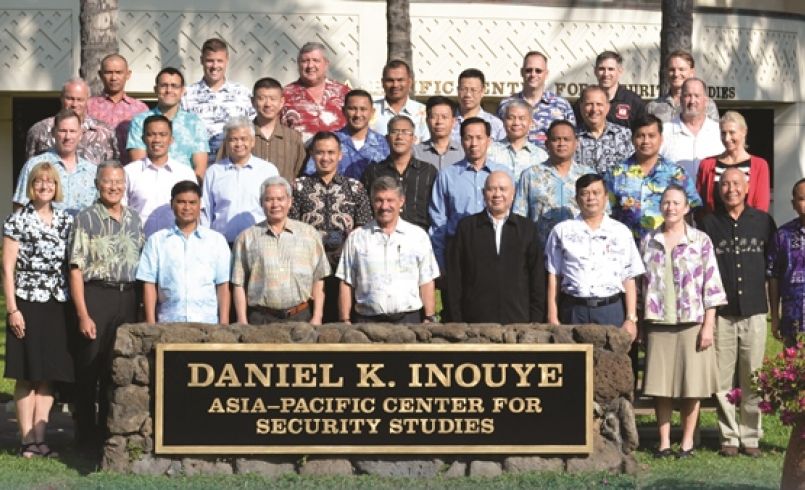
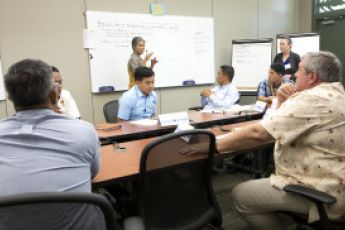
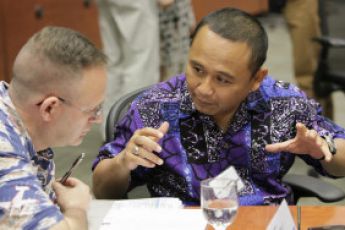
In an effort to advance regional cooperation in professional military education, the Daniel K. Inouye Asia-Pacific Center for Security Studies facilitated a three-day workshop, Jan 12 to 14, 2016. Titled, "Command and Staff Colleges in the Asia-Pacific: Next Steps Towards a Framework for Cooperation," the event brought together 27 participants from 11 nations representing 18 institutions from the region.
Command and Staff Colleges provide mid-grade military officers with advanced skills and knowledge in leadership, communication, and analytical skills to succeed in higher command and staff appointments. Colleges enhance the capacity of officers to perform a range of demanding duties at the strategic and operational levels in the broad range of senior deployments they encounter.
"If we can foster sharing of best practices and a common approach to curricula focused on critical areas, such as counterterrorism and disaster response, we believe it will go a long way in ultimately enhancing ASEAN's collective capabilities in these areas," said workshop manager Dr. Alfred Oehlers.
The week's CSC workshop was the second of its kind, with an earlier meeting held in January last year. The outreach focuses on institutions within ASEAN along with Australia, Japan, New Zealand and the United States.
DKI APCSS opened this year's event with an emphasis on security sector development and regional security architecture. Dr. Rouben Azizian, director of Massey University's Centre for Defence and Security Studies in New Zealand, addressed the importance of including both concepts in PME. "Military/security education should reflect the complexity of national and international security environments and promote a proactive and integrated way of addressing security challenges."
In breakout sessions following Azizian's brief, participants considered how their respective schools are preparing their next generation of leaders to contribute to their respective security sectors and the regional security architecture. Oehlers noted discussions recognized the need to emphasize defense diplomacy and international exchanges -- which lead to trust and mutual respect -- while building a common educational framework and terminology to better enable regional collaboration.
The workshop closed with participants agreeing to continue exploring potential paths toward institutionalizing the process of building CSC partnerships. As part of this effort, a working group was formed comprising colleges from Brunei, the Philippines and New Zealand, the Centre for Defence and Security Studies at Massey University, New Zealand, and DKI APCSS. The group will ensure continued progress in this arena and advocate for inclusion of agreed-upon priorities in forums such as the ASEAN Defence Ministers Meeting Plus (ADMM+), Annual Chiefs of Defense Conference (CHODS), and ASEAN Regional Forum Heads of Defence Universities, Colleges and Institutions Meeting (ARF HDUCIM).
"It (the workshop) was a major move toward progress... we achieved significant outcomes," said Lt. Col. Saiful-Akhmar Shariff, commandant of the Defence Academy, Royal Brunei Armed Forces. According to Saiful, he sees the group's initiatives strengthening the professionalism of the region's military forces while enhancing interoperability and building a more balanced perspective of regional issues.
Joining Saiful at this year's workshop were representatives from Cambodia, Indonesia, Japan, Malaysia, Myanmar, New Zealand, the Philippines, Thailand, the United States, and Vietnam. Australia participated in discussions via VTC.
The event was one of many APCSS outreach programs designed to strengthen partnerships among Asia-Pacific nations in security-related fields.
APCSS is a Department of Defense institute that addresses regional and global security issues. Military and civilian representatives from the United States and Asia-Pacific nations participate in a comprehensive program of executive education, professional exchanges and outreach events, both in Hawaii and throughout the Asia-Pacific region.
The Center supports the U.S. Pacific Command by developing and sustaining relationships among security practitioners and national security establishments throughout the region. APCSS' mission is to build capacities and communities of interest by educating, connecting and empowering security practitioners to advance Asia-Pacific security. It is one of the Department of Defense's five regional security studies centers.
Since opening in 1995, more than 9,700 alumni representing over 122 countries and territories have attended APCSS courses and workshops.
-End-
CSC14Jan16-3-300x188[1].jpg
CSC14Jan16-1-300x182[1].jpg