Japanese Crew Chiefs Seek 2/2 OPI Scores to Maintain Osprey
japanesecrewchiefs.jpg
By Joyce Tupola
Specialized English Instructor
It’s a bird…it’s a plane…it’s a helicopter! Actually, when you google “osprey,” it’s all three. In the world of Aviation, the Ospreys are a combination of a fixed wing plane and a rotary wing helicopter, which is why it is named after this bird of prey that has the ability to hover as well as fly straight. Osprey aircraft have a reputation of being rather dangerous, which earned them the nickname the “Widow Maker.” Over the years, however, their safety record has improved significantly.
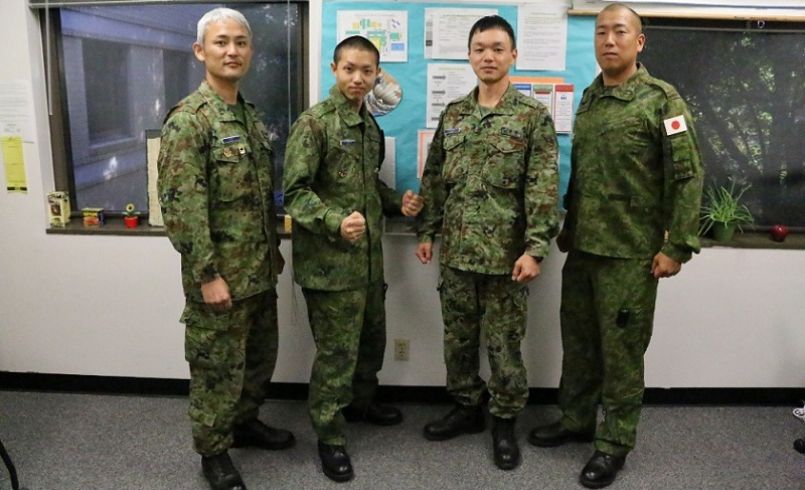
At DLIELC, there are four students from Japan (SFC Uemura, Master Sgt. Beppo, SFC Nagatomo and SFC Suzawa) who will be among the first Japanese maintainers to be crew chiefs for the Osprey in their country. They are very excited for the challenge and feel very humbled by this honor. They understand that this honor also comes with great responsibility. Nagatomo says, “Most Japanese think Osprey is a very dangerous aircraft. So we have to change their thinking. That’s why our responsibility is very big. Here [at DLIELC] we have to study English very hard, and after that, we have to study about Osprey very very VERY hard!”
Suzawa explained that Japan is one of the first countries to join the U.S. in incorporating Osprey into their forces. He adds, “If we can fly successfully, other countries [will] follow suit. So, as [Nagatomo] said, we have [a] huge responsibility. We have to prove the safety of it, the Osprey.”
Japan is introducing the Osprey into their Self Defense Forces because it is an effective way for Japan to reach many of their remote islands quickly and efficiently.
As a crew chief for the Osprey, each student is required to obtain an 85% on the ECL and a 2/2 on the OPI. It is unusual for maintainers to have the same requirements for English that the pilots are asked to obtain. Admirably, all four of these amazing students have met the ECL and OPI requirements.
How do these students feel about Osprey in general? Uemura says, “I think Osprey is [the] next generation aircraft because it can be transformed- fixed wing and rotary wing.” However, he acknowledges that some believe the “Osprey is very dangerous.”
Beppo explained, “This is a very new aircraft and every airplane that is new is a little bit dangerous because there are unknown problems.” He believes it is not any more dangerous than any other aircraft.
There was a bit of disagreement on this notion from Suzawa. In his opinion, “The Osprey is more dangerous than conventional helicopters because it converts from fixed wing or fixed mode, into helicopter mode. It’s not stable.” He believes this will cause more issues making the aircraft more dangerous than traditional ones. Despite any dangers, these students are not nervous, but enthusiastic to get started working with the Osprey.
As the four maintainers discussed the Osprey, they debated the human factor versus technology. Suzawa believes mechanics must have technique (skills) because it is complicated. They all agreed with this statement. Suzawa mentioned, “[The] Osprey is designed with new technology. When we have some problems we can just connect and check the computer. We can find out the errors [easily].”
Beppo disagreed and feels that a lot of computers can cause serious problems and not always work properly. He went on to share his experience of working with other choppers that have a lot of avionics. He explained, “This technology actually caused a lot of headaches for the maintainers. The systems would show a problem and then it would disappear, leaving the maintainers scratching their heads.” He concluded, “A simple airplane is the best. A sophisticated airplane is really difficult to maintain. Especially [when figuring] out the malfunctions.”
Another human factor was pointed out about Crew Resource Management (CRM) by Uemura. His main concern was about the dynamics of teamwork between crew chiefs, pilots, and others on the flight crew. He explained, “We have to work with each other without rank. No matter someone’s rank or position they are still human and can make mistakes. On the ground, I have to obey the rules [of rank], but when flying, sometimes I have to interrupt.” He concluded, “We have to build up CRM.” In his OPSAV courses, for the first time, he enjoyed being able to interact with pilots and study together where everyone was simply a student.
After they graduate from DLIELC, they will spend seven months in North Carolina at the Marine Corp Air Station New River, learning the responsibilities of an Osprey crew chief. However, the Marines require them to take a 2-week Basic Survival Course in Pensacola, Florida before their training at New River. Oorah! These students are well prepared and understand not only the challenges they face, but also the responsibility they have taken on themselves.