
Partnership for Peace Consortium of Defense Academies and Security Studies Institutes Home

Partnership for Peace Consortium of Defense Academies and Security Studies Institutes

  • Request new password
  • Login with PKI
Log in with CAC
Forgot Password?
  • Home
  • News
  • Activities
    • Defense Education Enhancement Program (DEEP)
    • Combating Terrorism (CT-WG)
    • Defense Education Development Working Group (EDWG)
    • Regional Stability in South East Europe (RSSEE-SG)
    • Regional Security in the South Caucasus Study Group (RSSC-SG)
    • Emerging Security Challenges Working Group (ESCWG)
    • Journal Connections
  • Products
  • About
  • GlobalNET LMS
  • Partnership for Peace Consortium of Defense Aca...
  • Republic of Moldova achieves significant milest...

Republic of Moldova achieves significant milestone towards NATO aspirations
Print Share Download PDF
0 comments

moldova-nato.jpg

Moldova-NATO
From PfPC | anonymous | 25 Jun 2015

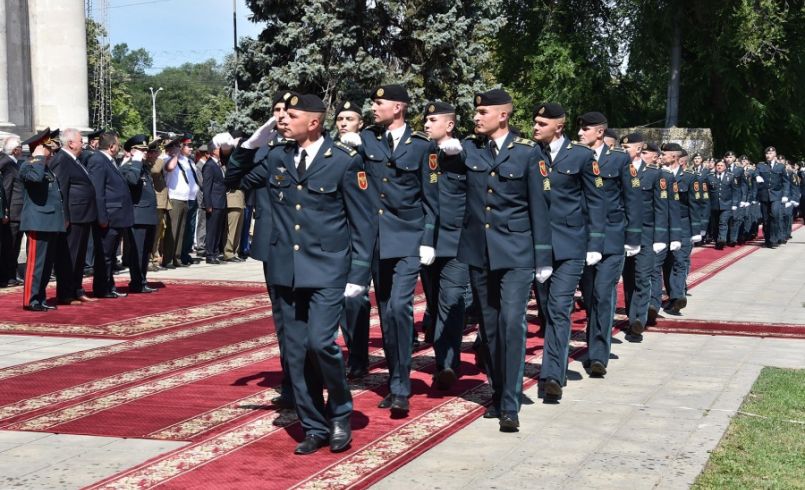
Chisinau, Moldova (June 29, 2015) – On 27 June, a graduating class of new officers from the Moldovan Military Academy ushered in a significant milestone in Moldova’s cooperation with NATO and partners. The graduation signaled the achievement of capacity for the Defense Education Enhancement Program (DEEP) in Moldova, a first of its kind event, as this is the first degree-granting course for new officers developed under the DEEP program.

The Minister of Defense Vorel Cibotaru, and other Moldovan leaders attended the graduation at the Moldovan Military Academy in Chisinau, during which time NATO officially declared capacity for the Moldova DEEP.

Defense education reform is an important part of Moldova’s Individual Partnership Action Plan (IPAP) with NATO, a roadmap of sorts that guides the country’s cooperative activities. Achievement of capacity for the DEEP program in Moldova is seen as a significant accomplishment, bringing Moldova further along the path to Western integration.

Since Moldova’s request to NATO in 2008 for defense education assistance under the DEEP program, NATO, the Partnership for Peace Consortium, the US Army War College, and the Romanian National Defense University have worked together to fully modernize the Moldovan Military Academy’s commissioning course for new officers.

A feather in the cap for the DEEP program, Moldova is a model of success for transformational change in defense education. Jointly managed by NATO and the Partnership for Peace Consortium, the DEEP program features multi-year cooperation plans with partner countries to assist with the modernization of defense education institutions. To date DEEP programs are underway in 13 countries: Afghanistan, Armenia, Azerbaijan, Croatia, Georgia, Iraq, Kazakhstan, Mauritania, Moldova, Mongolia, Serbia, Ukraine, and Uzbekistan.

Jean d’Andurain, Coordinator for Defence Education in NATO’s Political Affairs and Security Policy Division, in looking to the future said “NATO is excited about continuing our fruitful cooperation in the Moldova DEEP program, and in enlisting the expertise of the Moldovan Military Academy to help other partner nations follow in Moldova's footsteps."
Education and Training
See all tags »

Associated Files

Related Stories

Reform Defense Institutions
Security Sector Reform and Transformation
NATO and Partnership for Peace Consortium (PfPC) outline efforts to build, modernize and reform defense institutions in partner countries
Mongolia DEEP
Education and Training
Mongolia takes major step forward in defense education and NATO interoperability
See all related stories »
 

About PfPC

The Partnership for Peace Consortium (PfPC) of Defense Academies and Security Studies Institutes is a voluntary association of institutes of higher learning in defense and security affairs. Linking over 800 defense academies through a network of educators and researchers by sharing best practices and developing concrete solutions to common challenges.


About PfPC

Find us on Social Media

Footer: About GlobalNET

GlobalNET represents a network of organizations and their representative members who are working to foster national and international collaboration as well as to maintain relationships, and strengthen partner capacity.

Footer: GlobalNET Main Links

  • About GlobalNET
  • Contact GlobalNET
  • GlobalNET Partners

Footer: GlobalNET Partner

These are the GlobalNET partners

GlobalNET Support

  • Frequently Asked Questions
  • Help Desk
  • How to use GlobalNET
  • Privacy Policy
  • Terms of Use
  • Accessibility